

Taiko, Spirituality, and Natural Agriculture at Oxford Real Farming Conference 2026
In the early days of each new year, farmers, activists, and food systems leaders gather in Oxford, England, for the Oxford Real Farming Conference (ORFC). This year’s conference, held January 8-9, 2026, highlighted the growing conversation on the spiritual dimension of agriculture and the importance of grounding farming approaches in a deeper connection to and respect for nature.

Taiko Drumming during the ORFC 2026 Opening Plenary
The conference began with a special performance from Shumei Taiko Drummers during the Open Plenary. In Japanese culture, Taiko is traditionally offered as a prayer for harmony and conveys the sacred relationship between humankind and nature. At ORFC, the Taiko drummers served as a prayer for harmony and manifestation of Shumei’s belief that consciousness is linked to the vitality of the land. Their performance set the tone for a reflective and collaborative conference in Oxford–reminding participants that agriculture is a cultural and spiritual exchange with nature defined by farmer relationships to the land.
This year, Shumei hosted the session “Farmer Perspectives: Pathways to Healing People and Planet.” Chaired by Ben Raskin (Soil Association) the panel brought together farmers and agricultural leaders from India to Ireland to Zambia to explore how agricultural approaches predicated on harmony with nature–not fertilizers or addiitives–strengthen both ecological resilience and human wellbeing.
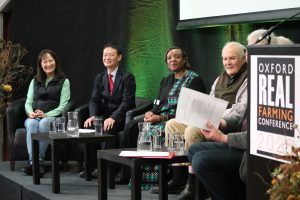
Special guest speaker, Satish Kumar (Schumacher College) opened the session. Following a recent visit to Japan, Satish spoke warmly of Shumei’s guiding principles of truth, virtue, and beauty, noting that these values are deeply needed in the world today.
Farmer and food system advocate Patrick Holden (Sustainable Food Trust) shared his own journey back to the land in Wales, describing farming as both physically demanding and spiritually grounding, requiring humility, perseverance, and constant inner striving. Irish apple farmer Rod Calder-Potts (Highbank Orchards) recounted his family’s long agricultural history and the difficult decision to abandon chemical farming after witnessing the decline of their land—an experience that eventually led to the restoration of their orchard through a more natural approach. From Zambia, Barbara Hachipuka Banda (Natural Agriculture Development Program Zambia) highlighted the work of women’s cooperatives using Natural Agriculture to restore soil health, strengthen food sovereignty, and revive indigenous knowledge systems. Lastly, Shumei Natural Agriculture farmer Shinya Imahashi (Shumei International) described his practice of cultivating crops through attentive observation, gratitude, and respectful dialogue with the natural world, demonstrating how patience and harmony with nature can transform even the most challenging land.
Together, panelists’ perspectives illustrated how agriculture can nurture not only resilient ecosystems, but also deeper awareness of humanity’s interconnected relationship with the Earth.
Throughout the conference, conversations amongst attendees and speakers returned to a shared realization: meaningful change in agriculture requires a renewed relationship with the land—one rooted in humility, gratitude, and respect for the living systems that sustain us.
In this spirit, the Oxford Real Farming Conference continues to create space for farmers, researchers, and advocates to come together to reflect on the deeper values that guide their work. From the opening rhythms of Taiko to the stories shared by farmers across continents, the gathering served as a reminder that when agriculture is practiced in harmony with nature, it has the power to nourish nature and the human spirit.